

Blog No 9 about the force that will decide the future of civilisation
There is a deeper illusion than energy abundance or food security. It is the illusion about water.
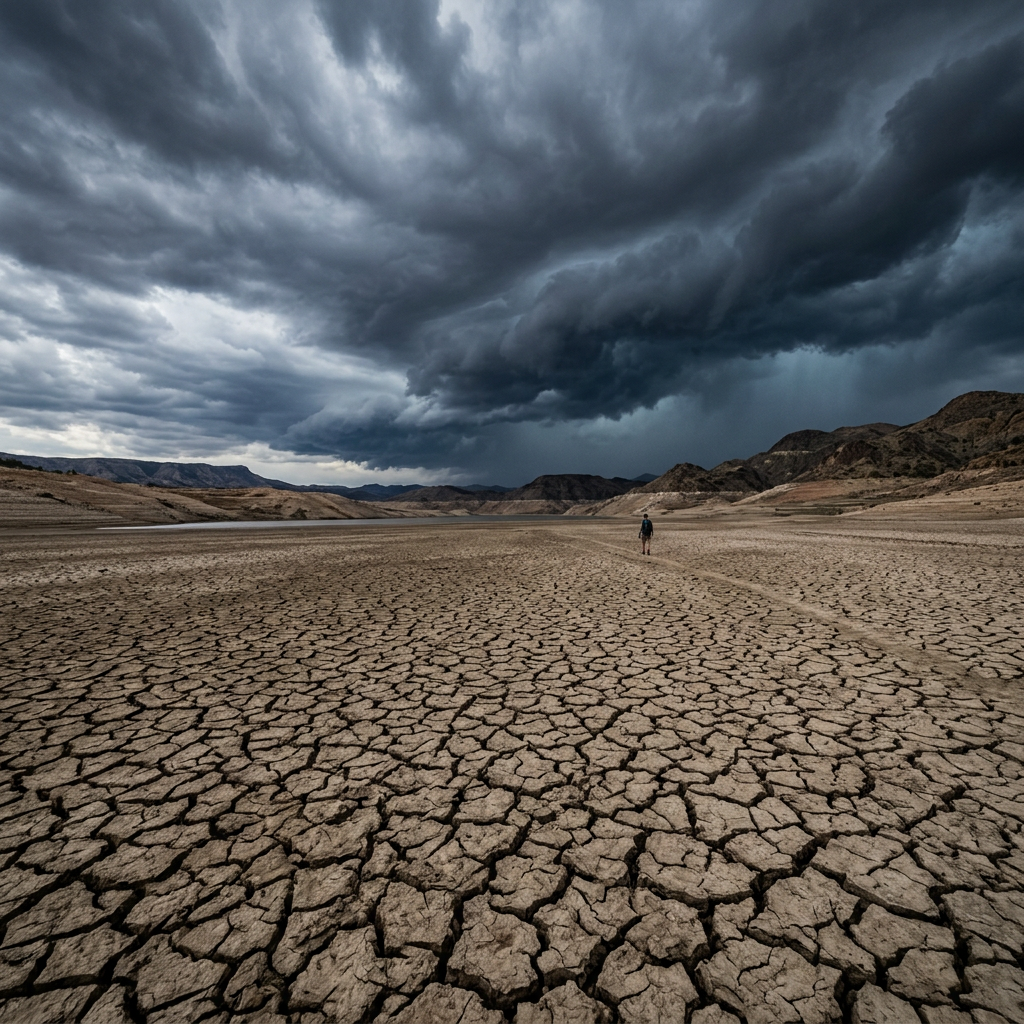
Water still flows from taps. Rivers still move. Crops still grow. Cities still expand. From the surface, the system appears stable, strained perhaps, but intact. Yet water does not fail dramatically. It does not collapse like a financial market or burn like a forest. It recedes quietly. It depletes invisibly. And when it finally breaks, it does so unevenly—first at the margins, then at the centre.
Water is not just another resource. It is the condition that makes all other systems possible. And it is becoming the decisive constraint of the 21st century.
The Convergence Point of Civilisation
Everything we have explored so far converges here. In Blog 7 – The Energy Dilemma, we saw that modern civilisation is built on dense, high-energy systems that are now under transition. In Blog 8 – Feeding Ten Billion, we saw that food production depends on soil, water, and a stable climate. Water sits at the centre of both.
It is the medium through which energy systems operate, cool power plants, generate hydropower, and enable fuel extraction. It is the lifeblood of agriculture. It shapes ecosystems, settlements, trade routes, and political boundaries.
Vaclav Smil describes modern civilisation as a network of tightly coupled systems in which energy, food, and materials flow through interdependent channels. Water is the medium through which many of these flows are sustained.[1]
This makes water different. Energy shortages can be substituted. Food shortages can be traded. Water has no substitute.
A Planet of Water — Will the world run out of water?
The paradox is striking. Earth is a water-rich planet. Yet only about 2.5 per cent of global water is freshwater, and less than 1 per cent is readily accessible for human use.[2]
For centuries, this limited supply was sufficient because human populations were smaller and ecological systems were intact. But the scale of modern civilisation has altered the balance.
Water demand has grown more than twice as fast as population over the last century.[3]
Agriculture consumes roughly 70 per cent of freshwater withdrawals, industry around 20 per cent, and domestic use the remainder.[4]. But these numbers obscure the deeper reality: water is unevenly distributed across geography and time. It arrives seasonally. It varies with the climate. It is stored imperfectly. It is easily polluted.
As UNESCO’s World Water Development Report emphasises, the emerging crisis is not only one of physical scarcity, but of management failure, ecological degradation, and institutional weakness.[5]
Water scarcity is therefore not simply about lack. It is about imbalance.
Groundwater: The Silent Exhaustion
The most critical, and least visible, dimension of the crisis lies underground. Groundwater has enabled the expansion of modern agriculture. It has allowed farmers to bypass unreliable rainfall. It has supported the rise of densely populated regions across India, China, the United States, and beyond. But this success carries a hidden cost.
Aquifers recharge slowly. In many cases, they are being depleted far faster than natural replenishment rates. The World Bank describes groundwater depletion as one of the most significant yet under-recognised threats to long-term water security.[6] The International Water Management Institute (IWMI) similarly warns that many of the world’s major food-producing regions are effectively operating on borrowed water.[7]
This creates an illusion of stability. Crops grow. Markets function. Populations expand. But beneath that stability lies a structural deficit. This is not a renewable use. It is an extraction.
Climate Change: Impact of climate change on water resources
If groundwater depletion represents a slow structural erosion, climate change represents a dynamic destabilisation. Water is the primary medium through which climate change manifests.
The IPCC’s Sixth Assessment Report makes this clear: changes in precipitation patterns, intensification of droughts, increased flood frequency, glacier retreat, and altered hydrological cycles will reshape water availability across regions.[8]. In South Asia, monsoon variability is already increasing. In parts of Africa and the Middle East, drought cycles are lengthening. In glacial-fed river systems, long-term flows are threatened by upstream ice loss.
For agriculture, this creates a new kind of uncertainty.
Traditional knowledge systems, planting cycles, rainfall expectations, and seasonal patterns become unreliable. What was once variability becomes volatility.
As Jared Diamond observed, environmental stress does not act alone. It interacts with political, economic, and social systems. When these systems are resilient, stress can be absorbed. When they are weak, stress becomes collapse.[9]
Water is now a primary channel through which such stress is transmitted.
The Energy–Water–Food Nexus
At this point, the illusion of separateness dissolves. Water is required to generate hydropower, cool thermal plants, and extract fossil fuels. Energy is required to extract, treat, and distribute water through pumping, desalination, purification, and urban supply systems.
Both are required to produce food. This is the energy–water–food nexus, but more importantly, it is the architecture of modern civilisation.
As Buckminster Fuller argued in Operating Manual for Spaceship Earth, humanity operates within a closed system where flows of energy and resources must be managed with precision.[10].
Disruptions do not remain isolated. A drought reduces hydropower output. Reduced energy affects irrigation. Lower irrigation reduces crop yields. Food prices rise. Social stress increases. What appears as a water problem becomes an economic problem, a political problem, and potentially a conflict.
Water Quality: The Erosion of Usability
Scarcity is only one dimension. Quality is another.
Industrial waste, agricultural runoff, untreated sewage, and chemical contamination have degraded water systems worldwide. Nutrient runoff from fertilisers leads to eutrophication, creating oxygen-depleted zones in lakes and coastal waters.[11]
The FAO and UNEP both highlight that water pollution reduces usable supply even where physical availability remains.[12]. This creates a dual constraint:
- Less water is available.
- And less of what remains is safe to use.
For rapidly urbanising regions, this is particularly dangerous. Water systems become overloaded, treatment capacity lags behind demand, and contamination spreads across both surface and groundwater systems.
Water, Power, and Geopolitics
Water does not respect political boundaries. Rivers cross nations. Aquifers span regions. Upstream actions affect downstream realities. This transforms water into a strategic asset.
From the Nile basin to the Indus system, from Central Asia to the American West, water-sharing arrangements are becoming increasingly complex and contested.
Kautilya, in the Arthashastra, recognised that control over natural resources underpins political power. Modern geopolitics reflects this principle in subtler forms through dam construction, diversion projects, infrastructure control, and policy leverage. Water rarely triggers immediate conflict. But it shapes long-term power.
Urban water crisis and solutions
This brings us directly to the next phase of the series. The world is urbanising rapidly. The United Nations projects that by 2050, nearly 70 per cent of humanity will live in cities.[13]
Cities do not produce water. They depend on it.
Urban water systems require complex infrastructure, dams, pipelines, treatment facilities, and distribution networks. As cities grow, they draw water from increasingly distant sources, often competing with agriculture and rural communities. Jane Jacobs emphasised that cities are systems of organised complexity. Water supply is one of the most critical—and fragile—elements of that complexity.[14]
As demand rises, systems stretch. As systems stretch, vulnerabilities multiply. The water crisis is therefore not only ecological. It is urban. And it is accelerating.
The Limits of Technological Optimism
Faced with these challenges, the instinct is to turn to technology.
Desalination. Wastewater recycling. Smart irrigation. Precision agriculture.
These are necessary, but not sufficient.
Desalination is energy-intensive. Recycling requires governance and infrastructure. Efficiency improvements can be offset by increased consumption, a phenomenon known as the rebound effect in the economic literature.
Rachel Carson warned that technological solutions, when divorced from ecological understanding, often create secondary problems.[15]. Technology can extend limits. It cannot eliminate them.
Rethinking Water
The real shift required is conceptual.
From extraction to stewardship. From fragmentation to integration. From short-term use to long-term sustainability.
This means:
- Managing water as a system, not a sector
- Protecting watersheds and ecosystems
- Improving agricultural efficiency
- Reducing pollution at source
- Integrating urban and rural water planning
It also means recognising a fundamental truth:
Water is finite. It always was.
The Real Question
So what does the future look like?
A world where water determines economic opportunity.
A world where cities compete with farms.
A world where climate variability amplifies inequality.
A world where water quietly shapes political decisions and social outcomes.
Or…
A world that recognises water as the central constraint—and redesigns systems accordingly.
This is not a technical problem.
It is a civilisational choice.
In Blog 7, we saw that energy powers civilisation. In Blog 8, we saw that food depends on soil and water. Here, the pattern becomes undeniable:
Energy, food, and water are not separate challenges. They are integral parts of one system.
And water may be the most decisive element of all. Because without energy, civilisation slows. Without food, it weakens.
But without water, it dies.
References
- [1] Smil, V. (2013) Energy and Civilisation: A History. MIT Press.
[2] UN-Water (2022) World Water Development Report.
[3] UNESCO (2024) UN World Water Development Report 2024.
[4] FAO (2017) Water for Sustainable Food and Agriculture.
[5] UNESCO (2024) World Water Development Report.
[6] World Bank (2016) High and Dry: Climate Change, Water, and the Economy.
[7] IWMI (2021) Water Security Report.
[8] IPCC (2023) Sixth Assessment Report – Synthesis.
[9] Diamond, J. (2005) Collapse. Penguin.
[10] Fuller, R.B. (1969) Operating Manual for Spaceship Earth.
[11] UNEP (2021) Global Environment Outlook.
[12] FAO (2019) Water Quality and Agriculture.
[13] UN-Habitat (2022) World Cities Report.
[14] Jacobs, J. (1961) The Death and Life of Great American Cities.
[15] Carson, R. (1962) Silent Spring.
Discover more from Open Book
Subscribe to get the latest posts sent to your email.
Published by
Leave a Reply