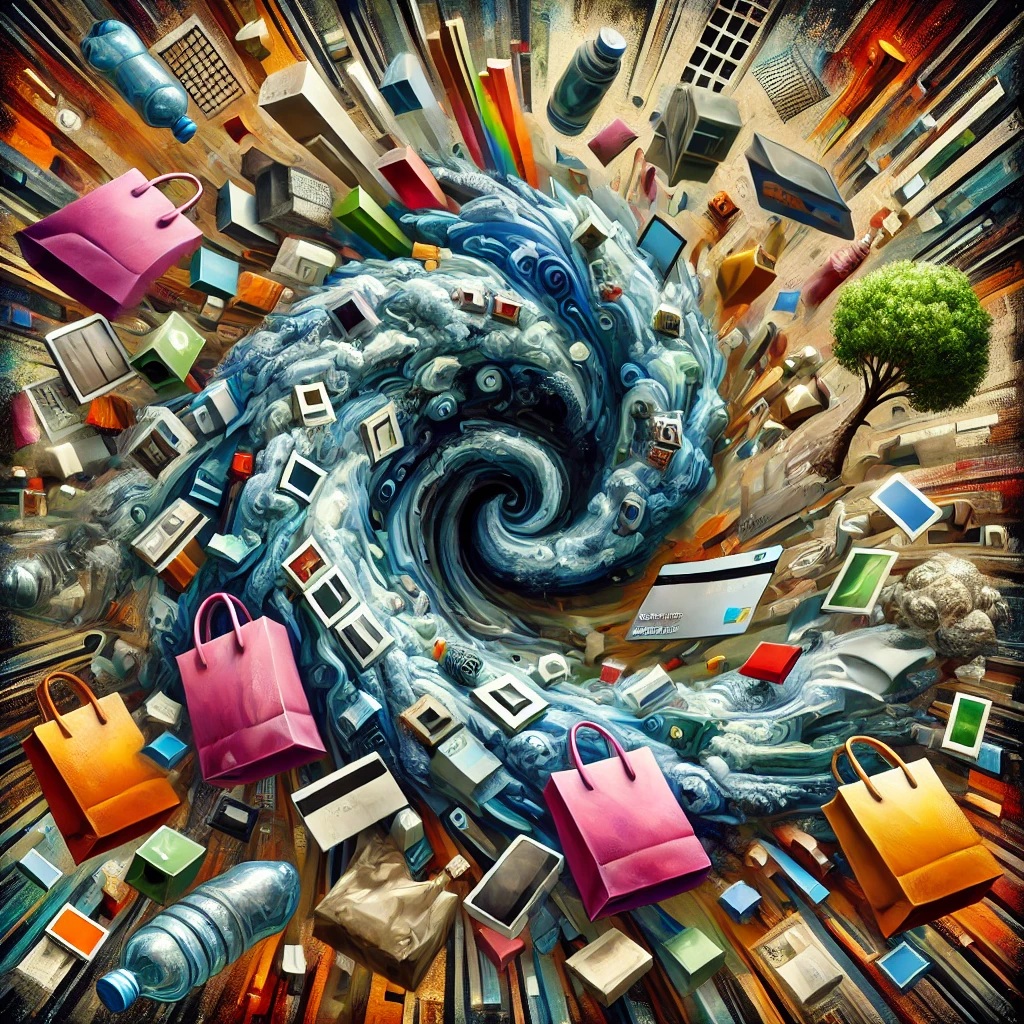


Blog 6 of the series – The Inheritance Series: Future of Humanity
Over-consumption is reshaping the planet. Discover how consumer culture, waste, and demand creation are pushing humanity beyond ecological limits.
Hello, I’m Raj Shekhar. Welcome to The Open Book. Here, we question the beliefs we rarely examine. We also explore the choices shaping our world. Nothing is off the table. Some questions may unsettle you. Some answers may challenge you. Because the future is being written right now—and we are holding the pens.
In the last blog, we confronted a troubling issue; the Growth Trap, the growth model driving modern economies. In this blog, we focus on the hungry consumption machine that we have created. It is devouring us. It is also destroying our home now.
There is a quiet violence built into modern life. It does not seem to be violence because it arrives wrapped in comfort, convenience and aspiration. It glows from screens and smiles from shop windows. It travels in delivery vans. It whispers through algorithms that seem to know us better than we know ourselves. Yet behind this polished surface lies a civilisation, organised not around “enough”. It is organised around “never enough”, serving as one of the central engines of ecological breakdown. This is the consumption machine, one of the deepest forces shaping humanity’s future.¹²
We often describe consumption as if it were simply the sum of millions of individual choices. That too is an innocent picture. Modern consumer culture is not merely a spontaneous expression of human desire. It is an economic system that depends on demand being expanded, refreshed and normalised at high speed. So, over-consumption is not a side effect of prosperity. It is built into the operating logic of growth-based economies. The products differ. The branding evolves. The platforms become more sophisticated. Yet, the underlying imperative remains the same: keep materials moving, keep goods circulating, keep attention restless, keep desires alive.²³⁴
Many have warned us
Seen through the lens of deeper intellectual traditions, this is where several long-standing warnings converge. Rachel Carson cautioned that modern systems can destroy the conditions of our life while still appearing successful. James Lovelock’s Gaia hypothesis reminds us of an important fact. The Earth is not an inert warehouse of resources. It is a living system with limits. Vaclav Smil highlights the physical foundations of civilisation. These foundations include energy, materials, infrastructure, and throughput. Meanwhile, Kate Raworth questions the fantasy of limitless economic expansion without breaching ecological ceilings. The consumption machine sits precisely at the intersection of these insights. It converts living systems into material flows, material flows into products, products into identity, and identity into ever-expanding demand.
For most of human history, consumption was constrained by effort, geography and necessity. Objects were repaired, reused and preserved because they embodied time and labour. But industrial capitalism altered this relationship. Mass production lowered costs, global trade widened access, and advertising transformed the meaning of consumption itself. Goods were no longer just tools. They became symbols of status, belonging, aspiration and emotional fulfilment. In the digital age, this transformation further deepened. Advertising no longer informs; it predicts, nudges and shapes behaviour. Research now suggests that modern advertising systems actively stimulate environmentally harmful consumption patterns while normalising unsustainable growth.⁵⁶

This recognition is important because ecological damage does not start at the point of disposal. It begins at the point of desire. What we call “waste” is not an accident at the end of a product’s life. It is embedded in the structure from the beginning. Modern economies run through a continuous chain that stretches from extraction through production, distribution, marketing, use and disposal.²⁷ What appears as individual choice at the end of this chain is often shaped by earlier decisions. These choices are managed outcomes, not coincidences.
The scale of this system is staggering. Global material extraction was 30 billion tonnes in 1970. According to UNEP’s Global Resources Outlook 2024, it has risen to over 100 billion tonnes today. It is projected to increase by another 60 per cent by 2060 if current trends continue. Resource extraction and processing contribute to over 60 per cent of global greenhouse gas emissions. They also cause a significant share of air pollution-related health impacts.¹ This is not simply a question of growth. It is a question of physical limits.
The concept of the material footprint helps reveal what is otherwise hidden. Every product carries a history of extraction, energy use, water consumption, and emissions.⁷ A smartphone holds dozens of mined elements. A garment may embody thousands of litres of water. A piece of furniture may represent forests cut far from where it is used. These hidden flows are rarely visible to consumers, yet they define the true environmental cost of modern life.
In this context, traditional economic measures become dangerously misleading. The World Bank’s work on wealth accounting makes a critical distinction between income and total wealth, including natural capital.³ A society may seem to grow richer in GDP terms. However, it might deplete the ecosystems that sustain its future. In such a system, apparent prosperity can mask underlying decline.
Consumption itself has now become a major driver of environmental stress. OECD research highlights that household consumption across goods, services, and mobility has profound environmental consequences. Demand-side changes could reduce global impacts by 40 to 70 per cent.⁴⁸ This is a remarkable insight. It suggests that the environmental crisis can’t be solved by production efficiency alone. It is also about how much we consume and why.
Modern systems are not neutral in this regard. They are structured to encourage escalation. Planned obsolescence shortens product life cycles. Marketing amplifies aspiration. Digital platforms intensify comparison. Policy frameworks prioritise economic throughput over durability. OECD guidance now explicitly calls for measures such as the right to repair. It also suggests restrictions on planned obsolescence. The guidance includes controls on misleading environmental claims.⁹¹⁰ These are not marginal corrections. They signal that the system needs to be redesigned.
The consequences are visible in global waste streams. Electronic waste is one of the clearest examples. The Global E-waste Monitor 2024 reports that the world generated 62 million tonnes of e-waste in 2022. Only about 22 % was formally collected and recycled.¹¹ This represents not only environmental damage but also a vast loss of recoverable materials. Waste, in this sense, is not merely the endpoint. It is evidence of systemic inefficiency.
Food waste tells a similar story. UNEP estimates that nearly one-fifth of all food available to consumers is wasted, even as hunger persists globally.¹³,¹⁴ This reflects a deeper dysfunction: a system capable of producing abundance, yet unable to distribute or utilise it rationally.
At a planetary level, these patterns culminate in ecological overshoot. Earth Overshoot Day marks the point at which humanity’s demand exceeds Earth’s capacity to regenerate within a year. In 2025, this date fell in July, indicating that humanity effectively consumed beyond sustainable limits for nearly half the year.¹⁵¹⁶ This is not a metaphor. It is a measurable imbalance between demand and regeneration.
The consumption machine is powerful because it operates through material systems. It also affects the human psyche. It exploits scarcity signals, amplifies social comparison and relies on the rapid fading of satisfaction. What we acquire quickly becomes normal, and what is normal soon feels insufficient. This cycle sustains demand without requiring genuine need.
In response, the idea of the circular economy has gained prominence. It seeks to close loops, reduce waste and extend product life cycles. It signifies a necessary shift towards sustainable consumption. But it also raises a difficult question. Can circular systems keep pace with ever-expanding demand? If consumption continues to grow, efficiency gains may be outstripped by scale.¹²
This brings us to the central paradox. The consumption machine is not malfunctioning. It is functioning exactly as designed. It rewards growth, stimulates demand, and normalises turnover. It leads to economic expansion and simultaneously generates ecological pressure.
And that leads to the defining question of our time.
Can a civilisation built on endless consumption survive within the limits of a finite planet? Are we confronting a deeper contradiction? This contradiction can’t be resolved without rethinking the very foundations of modern economic life.
The planet is not burning because we are unaware of it. It is burning because the system we designed equates progress with consumption and success with expansion. And that brings us to the next layer of this journey.
Consumption does not exist in isolation. The consumption machine is extremely hungry for energy. In addition to the materials used, every product, every service, every convenience is powered by something deeper: Energy. And that raises the next question: Can our civilisation sustain its appetite when the fuel itself is under strain?
Explore this in The Energy Dilemma in the next blog, Blog 7. We will explore the question of the energy that powers this entire consumption machine. Can our civilisation survive without fossil fuels?
Join me next Thursday on Open Book.
Follow The Inheritance Series to explore the full Future of Humanity series.
References
- United Nations Environment Programme (UNEP) (2024) Global Resources Outlook 2024. Nairobi: UNEP.
- United Nations Environment Programme (UNEP) (2021) Sustainable Consumption and Production Policies. Nairobi: UNEP.
- World Bank (2024) The Changing Wealth of Nations 2024. Washington, DC: World Bank.
- OECD (2024) Demand-side Policy Measures for Environmental Sustainability. Paris: OECD.
- Hartmann, P., Apaolaza, V. and D’Souza, C. (2023) ‘Advertising and climate change’, Journal of Advertising.
- OECD (2023) Consumer Vulnerability in the Digital Age. Paris: OECD.
- Sala, S. et al. (2019) ‘The consumer footprint’, Journal of Cleaner Production.
- OECD (2025) Demand-side Climate Mitigation Strategies. Paris: OECD.
- OECD (2026) Sustainable Consumption. Paris: OECD.
- OECD (2008) Promoting Sustainable Consumption. Paris: OECD.
- UNITAR and ITU (2024) Global E-waste Monitor 2024. Geneva: ITU.
- Bisschop, L. et al. (2022) ‘Planned obsolescence as environmental crime’, Crime, Law and Social Change.
- United Nations Environment Programme (UNEP) (2024) Food Waste Index Report 2024. Nairobi: UNEP.
- United Nations Environment Programme (UNEP) (2025) Food Loss and Waste. Nairobi: UNEP.
- Global Footprint Network (2025) Earth Overshoot Day.
- Global Footprint Network (2025) About Earth Overshoot Day.
6 responses to “The Consumption Machine: How Overconsumption is destroying the Planet”
-
An incredibly informative write-up. Knowledge exists in abundance and in silos but the facts from most authoritative sources were synthesized to connect the dots and bring to life these insights. That’s the beauty of this article and the entire series.
-
Thanks a lot for your support. Please share. Best regards
-
-
Such a wonderful article Raj on the topic consumption , covering the diocotomy of wastage and over consumption. The moot question being is the model we operate as a society is a sustainable one, I’m already excited about how you roped in the next topic “energy” to be able to extract to satisfy consumption from finite resources and I’m seriously all ears, waiting…..
Thanks for sharing. Loved it. -
Thanks a lot for your appreciation and support
-
The blog touches on a critical philosophical and economic tension, the infinite growth paradigm vs. planetary boundaries. You’re right to point out that ecological damage starts at “the point of desire.” We have shifted from a “needs-based” economy to a “wants-based” economy. In the digital age, the “social comparison” you mention is amplified by social media, creating a treadmill of consumption that doesn’t actually increase human happiness but does increase environmental debt.
The Jevons Paradox concept in economics suggests that as we make production more efficient (using less resource per item), we often end up consuming more of that item because it becomes cheaper or more accessible. This supports your skepticism on the “circular economy” if we don’t address the volume of consumption, efficiency gains will simply be “eaten” by increased demand.
I agree with your take on the overemphasis on GDP. Measuring a nation’s success solely by economic throughput is like measuring a person’s health solely by how much they eat. If a country cuts down its forests to sell timber, its GDP goes up, but its “Natural Capital” (total wealth) goes down. It’s like burning our furniture to keep the house warm.
To me, the solution probably lies in decoupling—finding ways to increase human well-being without increasing material throughput. This involves moving toward “access” rather than “ownership” and shifting our cultural definitions of success from what we own to how we live.
-
Dear Mr Menon, Thanks a lot for your very insightful observations. Sincere thanks for your support and appreciation


Leave a Reply