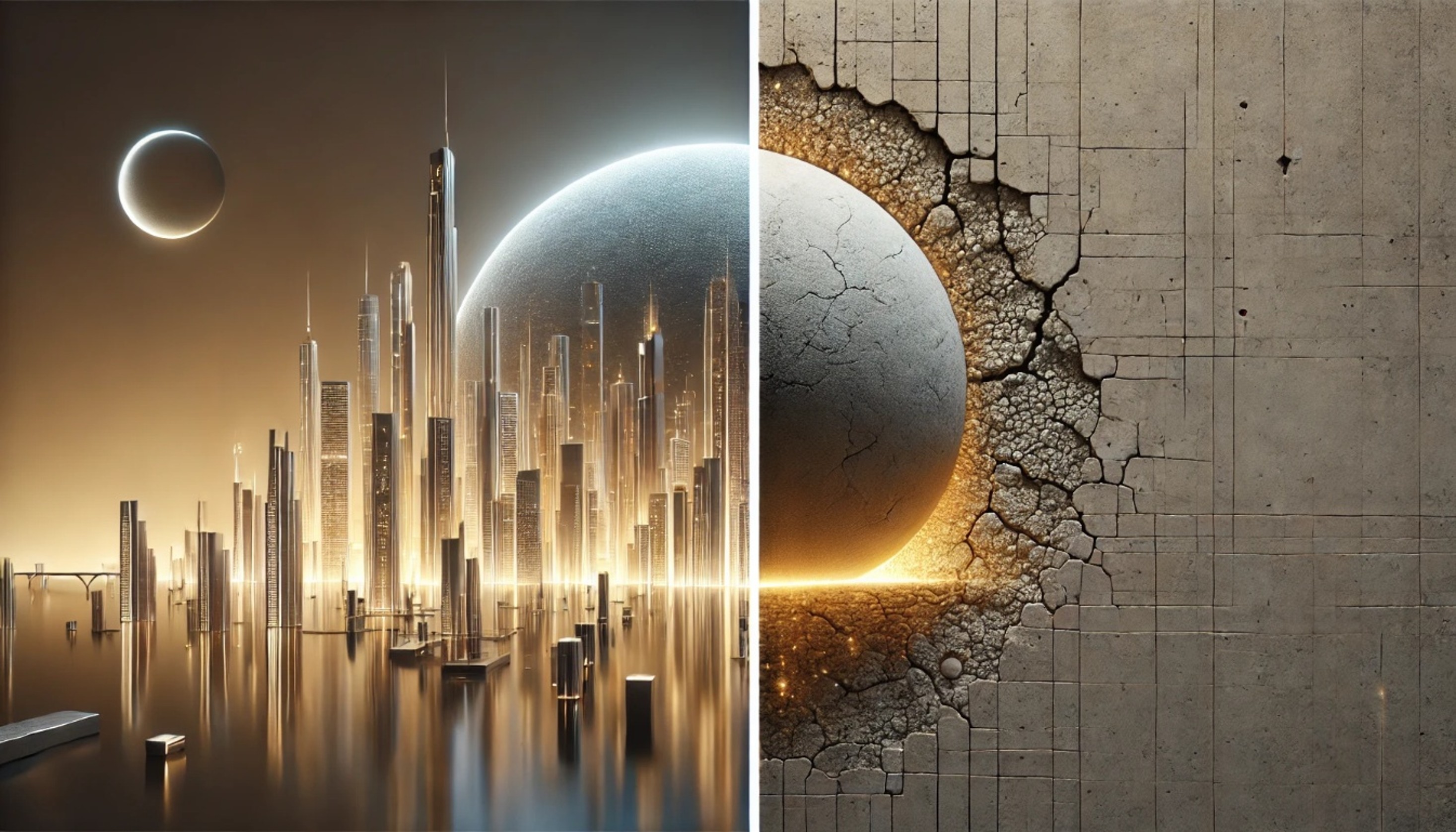


A powerful exploration of planetary boundaries and the future of humanity—revealing how close Earth is to its breaking point.
There is a dangerous illusion built into our lives today.
The lights still come on. Air conditioners hum. Water flows from the tap. Flights leave on time. Markets continue to speak of growth as if growth were a permanent law of nature. From the glass towers of our cities, the world still looks stable. The glow of our screens adds to this feeling of orderliness. It can even be reassuring.
But stability is not the same as health.
A bridge can stand long after its internal structure has weakened. A body can work even as disease spreads silently within it. A civilisation can be confident while quietly eroding the very systems that sustain it.
Are we there now?
For most of human history, we feared nature. We feared its storms, droughts, floods, and indifference. Nature was overwhelming; we were fragile. Today, for the first time, the balance has shifted. We are no longer shaped by the Earth. We are reshaping it.
And that changes the question completely. The old question was simple: how do we survive nature? The new question is far more unsettling:
Can and will nature continue to support us as we have always known?

The Limits We Never Saw
The idea that the Earth has limits is not new.
Thomas Malthus warned that the human population can outgrow the resources available to it. Rachel Carson revealed how modern industry can poison ecosystems. Buckminster Fuller urged us to think of Earth as a closed system—a spacecraft with finite supplies. James Lovelock described the planet as a self-regulating organism. Jared Diamond showed how civilisations collapse when they undermine their ecological base.
These voices came from different disciplines, different centuries, and different concerns. Yet they were talking around the same truth: Human ambition can’t be infinite on a finite planet.
In 2009, that intuition was given scientific form. Johan Rockström and his colleagues introduced the concept of planetary boundaries—a framework that defined a safe operating space for humanity.
For the first time, the warning was not philosophical. It was measurable.
The Systems That Keep the Planet Alive
The planetary boundaries framework identifies nine Earth system processes. These processes regulate the stability of the planet. They include climate change, biosphere integrity, and land-system change. Other processes are freshwater systems, biogeochemical cycles, and ocean acidification. Additionally, they cover atmospheric aerosols, ozone depletion, and novel entities like synthetic chemicals.
These are not environmental issues in the usual sense. They are the operating systems of the Earth.
They decide if rainfall remains predictable. They affect whether soils stay fertile. They influence whether oceans sustain life. They guarantee ecosystems keep the ability to recover.
The most important insight is this:
Civilisations exist in the space between these boundaries.
That space is where agriculture works, economies operate, and societies endure. And that space is shrinking.

Crossing the Line
Recent scientific assessments show that seven of the nine planetary boundaries have already been breached the limits.
Climate systems are destabilising. Biodiversity is declining at unprecedented rates. Freshwater cycles are under stress. Nutrient systems are overloaded. Chemical pollution is spreading beyond control. And now, even ocean chemistry is shifting.
This is not a future scenario. It is the current condition of the Earth system.
The real danger is that we are crossing limits.
The Myth of Gradual Decline
We imagine environmental damage as slow and linear.
A little worse each year.
A little more manageable.
A little more time.
But Earth systems do not behave that way. They absorb pressure. They compensate. They adapt. And then—under enough stress—they shift.
Suddenly. Irreversibly.
This is the logic of tipping points.
Ice sheets destabilise. Rainforests degrade into dry ecosystems. Coral reefs die abruptly.
Ocean currents weaken or reorganise. The IPCC warns that risks do not rise steadily. They accelerate sharply with warming. Beyond certain thresholds, impacts become widespread and difficult to reverse.
The danger is not just damage. It is destabilisation.
A System Under Pressure
The planetary boundaries are not independent. They are interconnected and cyclical.
Climate change intensifies water stress. Water stress weakens ecosystems. Weakened ecosystems absorb less carbon. Reduced carbon absorption accelerates climate change.
Again, land degradation alters rainfall. Nutrient overload damages oceans. Chemical pollution compounds biological stress.
This is not a list of separate problems. It is a system under tremendous pressure. And as more boundaries are crossed, resilience declines. This is how stability is lost—not through a single dramatic event, but through the gradual weakening of interconnected systems.
Overshoot: Living Beyond Our Means
These words define our current condition: ecological overshoot.
Humanity is now consuming resources faster than the Earth can regenerate them. We cut forests faster than they regrow. We extract water faster than it replenishes. We emit carbon faster than ecosystems can absorb. By current estimates, we are using the equivalent of 1.7 Earths to sustain our way of life.
This is not sustainable development. It is delayed depletion. We are not living on interest. We are consuming the capital.
The Silent Loss of Resilience
The Earth has always had an extraordinary ability to recover. Forests regrow. Rivers cleanse themselves. Ecosystems stabilise. This is resilience.
But resilience is not infinite.
Every boundary we cross weakens that capacity. Every ecosystem we degrade reduces its ability to absorb shocks. And once resilience drops below a threshold, small disturbances can trigger large consequences.
This is the phase we are entering now.
Not collapse. Fragility.
The Shrinking Safe Space
The most important idea in the planetary boundaries framework is not how far we have gone.
It is how little room remains.
The safe operating space for humanity is shrinking.
The buffers are weakening. The margins are narrowing. The system is becoming less forgiving. And for the first time in history, we are approaching these limits with full awareness of what we are doing.
Are We Near the Breaking Point?
There is no single moment when the planet “breaks.” No dramatic switch. No final warning bell. What happens instead is more dangerous.
The system becomes less predictable. Less stable. Less capable of supporting complexity.
The Intergovernmental Panel on Climate Change warns that the window to stabilise the Earth system is rapidly closing. This will happen not over centuries, but within decades.
The Earth itself will endure.
But the conditions that allowed human civilisations to flourish—stable climate, fertile soil, predictable water—are not guaranteed.
And that is what is now at risk. Not for the Earth. The risk is for us.
The Real Question
The greatest mystery is no longer our planet. It is us.
A civilisation that can measure its own destruction in real time… and still move towards it.
Not blindly, But knowingly.
We understand the limits. We see the risks. We even predict the consequences. And yet, the system does not slow.
Which raises a deeper, more unsettling possibility.
This is not simply a failure of awareness. It is something more structural.
Something embedded in the way our economies grow, our institutions work, and our societies define success. Because if a system continues to accelerate—even when it knows the cost, then the real question is no longer environmental.
It is systemic. What forces keep humanity moving in this direction… even when we know where it leads?
We call it progress. We call it growth. We call it development. But what if these are not choices at all? What if we are inside a system that can’t stop? A system that must expand, consume, and accelerate, even when it knows the cost. Because if that is true, then the question is no longer how the planet breaks. The question is:
What system is breaking us?
We have mapped the limits of the Earth with precision. We can see the thresholds, the tipping points, the shrinking safe space. The science is clear. The warnings are no longer distant. So the question is no longer about the planet. If we know we are crossing the line…why do we keep walking forward?
Join me in Blog 5: The Real Mystery — Why Don’t We Change?
The greatest risk we face is not what is happening to the Earth, but what is happening inside us.
Footnotes
- Rockström, J. et al. (2009). A safe operating space for humanity. Nature, 461, pp. 472–475.
- Stockholm Resilience Centre (2023). Planetary Boundaries Framework.
- Richardson, K. et al. (2023). Earth beyond six of nine planetary boundaries. Science Advances.
- Stockholm Resilience Centre (2025). Planetary Boundaries – Latest Update.
- IPCC (2023). Climate Change 2023: Synthesis Report.
- Global Footprint Network (2025). Earth Overshoot Day and Ecological Footprint Data.
- Meadows, D. H. et al. (1972). The Limits to Growth.
- Carson, R. (1962). Silent Spring.
- Lovelock, J. (1979). Gaia: A New Look at Life on Earth.
- Fuller, R. B. (1969). Operating Manual for Spaceship Earth.
- Diamond, J. (2005). Collapse: How Societies Choose to Fail or Survive.
2 responses to “Planet Under Pressure”
-
This is such a powerful and important piece. Even from what I’ve read so far, the way you connect complex environmental challenges with real-world consequences is incredibly thought-provoking. It really makes you pause and reflect on our role in all of this.
What I admire most is how you don’t just present the problem, but also push the reader to think deeper about responsibility and change. In a time where issues like climate change, biodiversity loss, and rising environmental stress are becoming more intense , writing like this truly matters.
Really looking forward to finishing the rest—brilliant work as always 👏
-
Thanks a lot . I am very glad that young people like you take these very seriously. You have a huge role to play. Thanks
-


Leave a Reply