

Blog 2 of the series: The Inheritors
Are There Too Many Humans? The Overpopulation Question the World Avoids.
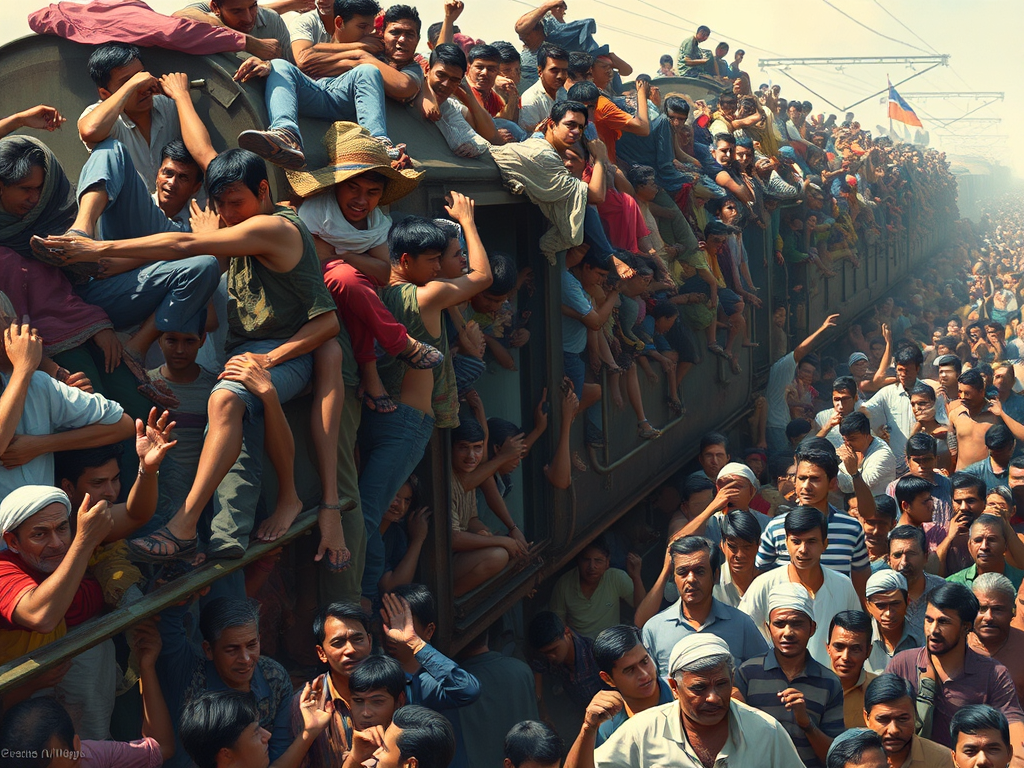
The train was already full when we boarded. But we kept pushing people in. No one wanted to be the one who said, “Enough.”
In 1916, about 1.8 billion of us were here.¹ That was the world of our great-grandparents. Vast forests stood. Rivers ran clear. The oceans seemed endless. Today, we are more than 8 billion.² By 2050, we are expected to approach 10 billion.³
In one century, we multiplied more than four times. Four times the mouths. Four times the water demand. Four times more pressure on the land and oxygen. Four times the waste. Yet we speak of growth as if it were automatically virtuous. There is something deeply dishonest about this conversation.

Infinite growth on a finite planet
We celebrate declining child mortality. We applaud longer life expectancy. And rightly so. Medicine has pushed back death. Sanitation has erased plagues. Vaccines have rewritten destiny.⁴ But here is the question we avoid: Can a finite planet support infinite multiplication?
Every ecosystem has a carrying capacity, a limit beyond which degradation begins.⁵ This is not ideology. It is biology. Even bacteria in a dish eventually hit their limit.
We tell ourselves we are different because we have technology. Thomas Malthus warned in 1798 that population grows geometrically while food grows arithmetically.⁶ He was ridiculed. And for a time, he appeared wrong. The Green Revolution intervened. We outran the limits with fertilizers, irrigation, genetic engineering, and machinery. But outrunning a limit is not eliminating it.
Agriculture now consumes about 70% of the world’s freshwater.⁷ Livestock occupies nearly 80% of agricultural land while providing a fraction of global calories.⁸ Forests are cut to grow feed for animals. Aquifers are sinking. Soil is eroding faster than it forms. At the same time, climate change is already reducing crop yields in vulnerable regions.⁹
We are not simply many. We are many and hungry. And not just hungry for food — hungry for meat, for energy, for comfort, for endless consumption. Let us stop pretending this is neutral.
More people mean more voters, more believers, more consumers. Political parties grow with more followers. Religious institutions want more believers. Corporations profit from more customers. Governments love more taxpayers.
But who bears the cost?
Fertility rates stay highest in the poorest and most climate-vulnerable regions.¹⁰ Growth is fastest where resilience is weakest. Meanwhile, the affluent consume exponentially more per person.¹¹ A child born into wealth leaves a carbon footprint dozens of times larger than one born into poverty. So, when we speak of overpopulation, we must speak of overconsumption.
Both are part of the equation. More bodies plus higher appetites equals exponential strain.
The cities tell another story. More than half of the world already lives in urban areas.¹² By mid-century, nearly 70% will crowd the cities.¹³ Slums swell. Infrastructure cracks. Heat intensifies. Floods multiply. We stack humans into towers and wonder why mental health fractures.
Water grows scarce.¹⁴ Rivers shrink. Aquifers empty. History tells us what follows scarcity: conflict.¹⁵ When resources tighten, tribal identity hardens. We have seen it already; nationalism rising, migration weaponised, and neighbours turning suspicious.¹⁶
We retreat into smaller identities just when planetary cooperation is most urgent. And still we refuse to speak plainly about numbers. Why? Because numbers are sensitive. They touch religion. They touch politics. They touch the family.
Let us look at religious teachings.
The Bhagavad Gita conveys the importance of balance. It emphasizes acting in harmony with the order of the world, not in reckless desire.¹⁷ The Isha Upanishad opens with a warning: “All this is pervaded by the Lord… enjoy through renunciation. Do not covet what belongs to another.” ¹⁸
The Bible speaks of stewardship, humanity placed in the garden “to till it and keep it.” ¹⁹ Keep it, not exhaust it.
The Quran speaks of balance (mizan) in creation and warns against transgression of that balance.²⁰
The Buddha taught that craving leads to suffering.²¹
Craving more land. More meat. More wealth. More dominance. More numbers. All our spiritual traditions warn against excess, but our economic systems glorify it. And we stand between them, pretending the contradiction does not exist. We don’t want to look at the dinosaur in the room.
Some futurists now speak casually of arresting, and reversing ageing; even making death optional.²² Imagine the chaos when longer lives are added to rising populations without natural attrition.
We cheer technological breakthroughs but refuse to recognise and act on the demographic issues. It is a dangerous combination. Let us be blunt.
If we continue to expand our population while resisting consumption reform, the correction will not be gentle. Nature has its own mechanisms of adjustment. Famines. Diseases. Conflicts. Collapses. We saw a trailer of that and stood watching helplessly during the Covid epidemic. Ecological correction is inevitable when limits are ignored.

The Global Footprint Network estimates that humanity consumes ecological resources faster than Earth can regenerate them each year.²³ We are in overshoot, and overshoot is not abstract. It is forests burning in record heat. It is marine life collapsing. It is soil turning to desert. It is climate refugees crossing borders. We call them crises. Ecology calls them consequences.
Now come the uncomfortable moral questions.
- Is it compassionate to bring children into a system we know is under escalating stress?
- Is it ethical to demand unlimited growth on a limited planet?
- Is it wise to assume innovation will indefinitely save us from arithmetic?
The consistent education of girls stabilises fertility rates.²⁴ Voluntary family planning works.²⁵ Dietary shifts can drastically reduce land and emissions pressure.²⁶
Some very powerful tools exist. But we need courage to use them. At the macro level, this demands policy shifts:
- Universal education.
- Reproductive autonomy.
- Sustainable agriculture innovation.
- Consumption reform in wealthy nations.
- Global cooperation beyond tribal politics.
- More equitable distribution of resources
But at the personal level, it demands something harder. Restraint and Discipline.
It can also mean choosing smaller families, choosing less consumption, choosing plant-based diets. Choosing leaders who prioritise sustainability.
No law forces us to waste water. No religion forces us to excess consumption. No politician can compel us to abandon reason. We can’t outsource moral responsibility to other individuals or institutions.
The Upanishads remind us that the world is one family, Vasudhaiva Kutumbakam.²⁷ Then every member of that family must be cared for without destroying the household.
A household has limits. A planet does too. This is not anti-human. It is pro-future. Because the question is not how many we can physically cram onto the train. The question is whether the train will still have air to breathe, water to drink, and stability to run.
We are the first generation with full visibility of the numbers. We are possibly the last generation with the choice to act voluntarily. If we don’t act. we will have to react violently or helplessly watch corrections forced on us. Arithmetic does not negotiate. Nature does not hold elections.
The train is still moving. Its doors are open. The question left is whether we will manage the crowd wisely or wait for the train to break down.
Footnotes
- Roser, M., Ritchie, H. and Ortiz-Ospina, E. (2013) World Population Growth. Our World in Data.
- United Nations (2022) World Population Prospects 2022.
- United Nations (2022) ibid.
- WHO (2023) World Health Statistics.
- Wilson, E.O. (2016) Half-Earth.
- Malthus, T.R. (1798) An Essay on the Principle of Population.
- FAO (2022) State of the World‘s Food and Agriculture.
- Poore, J. and Nemecek, T. (2018) Science, 360(6392).
- IPCC (2023) Sixth Assessment Report.
- World Bank (2023) World Development Indicators.
- Smil, V. (2017) Energy and Civilisation.
- UN-Habitat (2022) World Cities Report.
- UN-Habitat (2022) ibid.
- IWMI (2022) Water Security and Agriculture.
- Sachs, J. (2015) The Age of Sustainable Development.
- Harari, Y.N. (2018) 21 Lessons for the 21st Century.
- Bhagavad Gita 3:14–16.
- Isha Upanishad, Verse 1.
- Genesis 2:15, The Bible.
- Quran 55:7–8.
- Dhammapada, Verse 212–216.
- Cordeiro, J.L. and Wood, D. (2018) The Death of Death.
- Global Footprint Network (2023) National Footprint Accounts.
- Sen, A. (1999) Development as Freedom.
- UNFPA (2022) State of World Population.
- EAT-Lancet Commission (2019) The Lancet.
- Maha Upanishad VI.71–73.
6 responses to “We are too many here!”
-
Dear Raja, you say “Smaller family”. What do you mean by it??? “One child” norm or “Two children” norm or something else???? In Kerala, many families of one group are now restricting themselves to one child while those of another group are growing at unrestrained rates. This is creating unhealthy demographical imbalances. What is the solution for this??
Illegal immigration in North Eastern states have created demographical imbalances there. What is the solution for it??
In Europe and UK, immigrants outnumber locals. I read an article which says that locals are unhappy with their value systems being destroyed by burgeoning immigrants but are hesitant to voice their opposition for fear of being labeled narrow minded. A video I saw shows a man ransacking a super market in Germany, because it was open during his holy month. It is due to a clash of differing religious beliefs and refusal of immigrants to accept local customs and insistence on imposing their value systems on the guest country and its population. Where is it all going to end???
When ideology overwhelms common sense, the result is chaos. It leads to wars and pestilence and mass extinction.
Majority of people are only concerned with themselves and theirs and hardly bothered about others.
Until and unless we have enlightened leadership, all over the world, mistakes will multiply.
Environmental and ecological issues will take a backseat and narrow political interests will rule the world.-
Dear Girish, Thanks for your view. There is no straight forward solution. But that is no reason to ignore the issue. Mother earth doesot care about our man-made groupings of people, nationalities, religions, races etc.If we can create these issues we can also solve them if we recognise it as a problem and how detrimental it is for our existence. But we need a different kind of leaders. Because the problems created by one level of thinking can only be solved by a different or a higher level of thinking.
-
Dear Raja, i agree with most of your replies. However, we need such enlightened leaders in every country, don’t we??? i don’t see any such one in any country today. You say any problem needs a different or superior intelligence to solve it. There are some problems that simply can’t be solved; for example, in 1991, i thin, the PV Narasimha Rao government enacted the Waqf Bill Act which has caused innumerable problems across India, and the Supreme Court has not taken up the plaints filed against it, even after 8 years. Instead, it chose to hear plaints against the Bill passed last year, modifying the original Law.
Again, in 2001, the Vajpayee government passed the bill prohibiting killing of dogs. Across India there are millions of stray dogs and thousands of people, children, women and old people, are being bitten by them every day. The SC took up the issue on a suo moto basis but could not reach any conclusion even after many sittings due to objection by “Animal Lovers” and others, backed no doubt by pharma companies making rabies vaccines…..
-
-
-
I understand all that you are saying . But where do we go from there? 1. To accept the mess we are in and give up. 2.,Do whatever we can to change it. I have chosen option 2
-
We cannot give up, Raja. We owe it to our children and their children a better life, a better world.
But for that we need men of action. Do you see any on the horizon????? anywhere in the world.-
Thanks. I believe each crisis will bring out the right leader. History is full of them. Let us raise awareness of the problems and the need for change
-
-


Leave a Reply